
Table of Contents
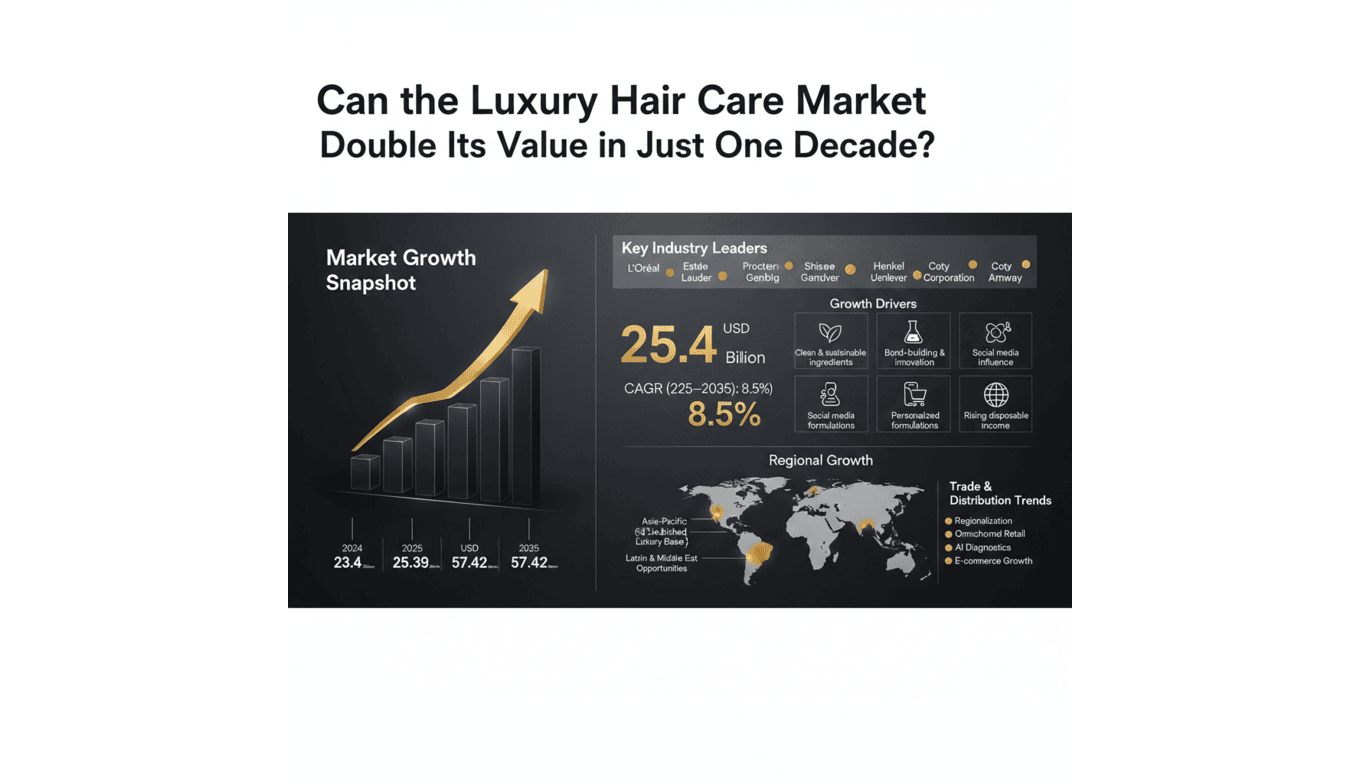
The Luxury Hair Care Market is experiencing remarkable growth, driven by increasing consumer demand for premium formulations and sustainable ingredients. Valued at USD 23.4 billion in 2024, the market is projected to reach USD 25.39 billion in 2025 and surge to USD 57.42 billion by 2035, registering a robust compound annual growth rate (CAGR) of 8.5% during the forecast period from 2025 to 2035. This exponential expansion reflects a fundamental shift in consumer preferences toward high-quality, ingredient-conscious hair care solutions that deliver both performance and luxury experiences.
The competitive landscape of the luxury hair care market is dominated by established global beauty conglomerates that continue to innovate and expand their premium product portfolios. Key players profiled in this market include L’Oreal (France), Estée Lauder (United States), Procter & Gamble (United States), Shiseido (Japan), Unilever (United Kingdom), Henkel (Germany), Coty (United States), Kao Corporation (Japan), and Amway (United States). These industry leaders are investing heavily in research and development to create cutting-edge formulations that incorporate botanical extracts, biotech-derived ingredients, and personalized solutions tailored to specific hair types and concerns. The intensifying competition has accelerated product innovation cycles, with brands racing to capture the attention of discerning consumers willing to invest in premium hair care regimens.
Access Free Sample Copy – https://www.marketresearchfuture.com/sample_request/21926
Regional Overview
North America currently dominates the luxury hair care market, accounting for the largest revenue share due to high disposable incomes, strong brand awareness, and a mature beauty industry infrastructure. The United States leads regional growth, with consumers increasingly gravitating toward salon-quality products for at-home use. Europe represents the second-largest market, with countries like France, Germany, and the United Kingdom driving demand for organic and sustainable luxury hair care solutions. The region’s stringent regulations on cosmetic ingredients have pushed brands to develop cleaner, more transparent formulations that resonate with environmentally conscious consumers.
The Asia-Pacific region is emerging as the fastest-growing market for luxury hair care, propelled by rising affluence in countries such as China, Japan, South Korea, and India. The growing middle class in these nations is increasingly exposed to Western beauty standards while simultaneously seeking products that address region-specific hair concerns like humidity damage and pollution protection. South Korea’s K-beauty influence has particularly catalyzed interest in innovative hair care technologies and multi-step treatment routines. Meanwhile, the Middle East and Africa region shows promising growth potential, with increasing urbanization and exposure to international beauty trends driving demand for premium hair care products among affluent consumers.
Segmentation Analysis
The luxury hair care market is segmented by product type, including shampoos, conditioners, hair masks, serums, styling products, and treatment solutions. Hair serums and treatment products are experiencing the fastest growth due to their targeted efficacy in addressing specific concerns like frizz control, hair loss prevention, and damage repair. By price range, the market spans ultra-premium, premium, and accessible luxury segments, with ultra-premium products commanding significant market share among high-net-worth individuals seeking exclusive formulations and limited-edition collections.
Access Full Report – https://www.marketresearchfuture.com/reports/luxury-hair-care-market-21926
Distribution channels play a crucial role in market dynamics, with segmentation across specialty stores, department stores, online retail, salons and spas, and direct-to-consumer platforms. E-commerce has emerged as the fastest-growing distribution channel, accelerated by the pandemic-induced shift toward digital shopping and the convenience of home delivery. Online platforms enable brands to offer personalized recommendations, subscription services, and exclusive product launches that engage tech-savvy consumers. However, physical retail channels remain important for luxury hair care, as consumers value the sensory experience of testing products and receiving expert consultations from beauty advisors.
Driving Factors and Trends
Multiple factors are propelling the luxury hair care market’s impressive growth trajectory. The rising awareness of hair health and the connection between scalp wellness and overall hair quality has driven consumers to invest in premium products formulated with scientifically-backed ingredients. The clean beauty movement has gained substantial momentum, with consumers demanding transparency in ingredient sourcing and manufacturing processes. Brands responding with sulfate-free, paraben-free, and cruelty-free formulations are capturing significant market share among ethically-minded consumers.
Personalization represents a transformative trend in the luxury hair care sector, with brands leveraging artificial intelligence and diagnostic technologies to create customized formulations based on individual hair profiles, environmental factors, and lifestyle considerations. The integration of sustainable practices throughout the supply chain—from biodegradable packaging to carbon-neutral production facilities—has become a competitive differentiator as environmental concerns influence purchasing decisions. Additionally, social media influence and celebrity endorsements continue to drive aspirational consumption, with beauty influencers and hairstylists shaping consumer perceptions of luxury hair care effectiveness and desirability.
The proliferation of professional-grade products for at-home use has blurred the lines between salon and consumer markets, with brands offering salon-exclusive technologies in retail formats. Innovations in biotechnology are enabling the development of next-generation ingredients like plant stem cells, peptides, and microbiome-balancing compounds that deliver transformative results. The growing male grooming segment also presents substantial opportunities, as men increasingly embrace comprehensive hair care routines that extend beyond basic shampooing.
Geopolitical Impact: Iran-Israel-USA Tensions
The escalating tensions involving Iran, Israel, and the United States are creating significant ripple effects across the luxury hair care market, particularly affecting supply chain operations and raw material procurement. Many premium hair care brands source exotic botanical ingredients, essential oils, and specialty chemicals from regions proximate to or dependent on Middle Eastern trade routes. The heightened geopolitical instability threatens the consistent availability of ingredients like argan oil, rose extracts, and specialty surfactants, potentially forcing manufacturers to secure alternative suppliers or reformulate products.
The luxury hair care market’s reliance on sophisticated packaging materials—including high-quality glass bottles, sustainable bamboo components, and premium dispensing mechanisms—makes it vulnerable to logistics disruptions. Container shipping routes through critical chokepoints are experiencing delays and increased insurance premiums, directly impacting product launch timelines and inventory management for luxury brands operating on just-in-time delivery models. These disruptions may force brands to increase prices or accept lower profit margins, potentially affecting market growth projections in the near term.
GLOBAL SUPPLY CHAIN & MARKET DISRUPTION ALERT
Escalating geopolitical tensions in the Middle East, particularly around the Strait of Hormuz and the Red Sea, are creating significant disruptions across global energy, chemicals, and logistics markets. Critical shipping corridors are under pressure, with major oil, LNG, petrochemical, and raw material flows at risk, triggering supply chain delays, freight cost surges, insurance withdrawals, and heightened price volatility. These disruptions are increasing operational risks and cost uncertainties for industries dependent on global trade routes and energy-linked feedstocks.
FAQs
Q: What are the emerging technologies transforming luxury hair care product development?
A: Advanced technologies revolutionizing the luxury hair care market include AI-powered personalization platforms that analyze individual hair DNA and microbiome composition, nanotechnology for enhanced ingredient penetration, 3D-printed customized hair care devices, and blockchain-based supply chain transparency systems. Additionally, biofermentation technology is enabling brands to create sustainable alternatives to traditional ingredients while maintaining or exceeding efficacy standards.
Q: How are luxury hair care brands addressing the challenge of counterfeit products?
A: Leading luxury hair care brands are implementing sophisticated anti-counterfeiting measures including NFC-enabled smart packaging, QR code authentication systems, blockchain-verified supply chains, and holographic security labels. Many brands are also partnering with authorized retailers and strengthening their direct-to-consumer channels to ensure product authenticity. Educational campaigns help consumers identify genuine products through packaging details, batch codes, and authorized seller verification.
Read Our Related Report:
Men Hair Color Market –
https://www.marketresearchfuture.com/reports/men-hair-color-market-9437
Hair Curling Irons Market –
https://www.marketresearchfuture.com/reports/hair-curling-irons-market-10662
Hair Colorant Market –
https://www.marketresearchfuture.com/reports/hair-colorant-market-41835
Hair Gel Market –
https://www.marketresearchfuture.com/reports/hair-gel-market-41841
Beauty Products Market –
https://www.marketresearchfuture.com/reports/beauty-products-market-55355